The electric potential V at a point is defined as the work done per unit positive charge to bring a small test charge q from infinity (where the potential is zero) to that point.
- If the force is repulsive (positive sphere vs positive test charge), positive work must be done against the electric field to bring q closer. This increases potential.
- If the force is attractive (negative sphere vs positive test charge), the electric field does work on the test charge. This decreases potential.
By definition, potential at the point is equal to
In this equation, the negative sign is essential. When a positive test charge is brought from infinity toward a positively charged sphere, the two charges repel. By Newton’s Third Law, the sphere exerts an outward force on the test charge, and the test charge exerts an equal inward force on the sphere. To move the test charge inward against this repulsion, an external agent must apply a force equal in magnitude but opposite in direction to the electric force. If we define the direction of the electric field as the conventional positive direction, then the force applied by the external agent—which opposes the field (F = – qE)—must carry a negative sign relative to that convention.
The electric field E is given by
Substituting it into the integral, we get
Comparison with Gravitational Potential
| Potential Type | Formula for Point Source | Sign |
|---|---|---|
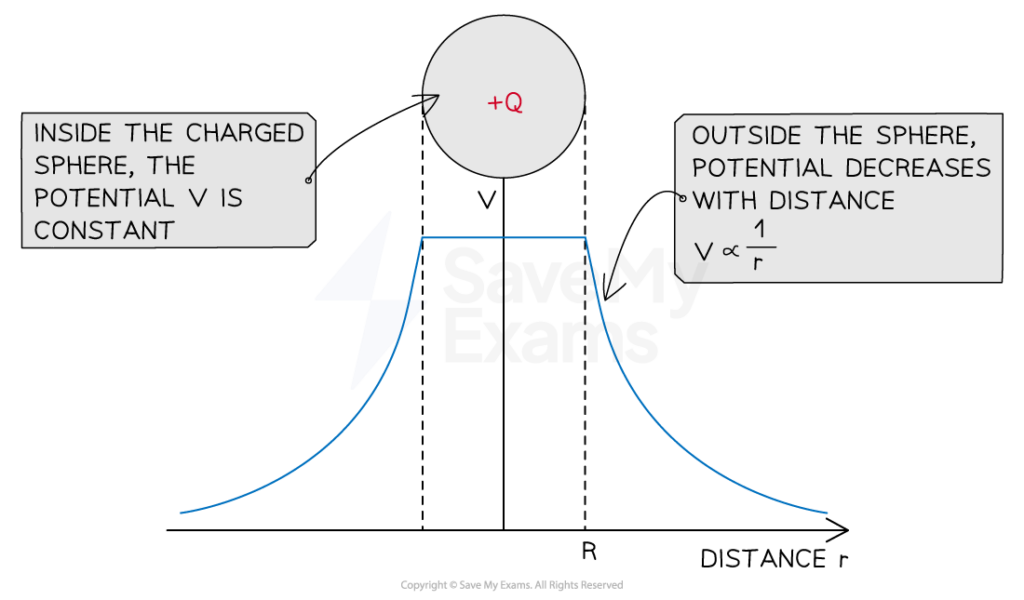
| Electric Potential | V(r)=rkQ | Can be positive or negative depending on Q |
| Gravitational Potential | Φ(r)=−rGM | Always negative (for finite r) |
The direction of the force (attractive vs. repulsive) is built into the sign of Q for electric potential.
That’s why does not need an extra minus sign in front—the sign of Q already tells us whether the potential is positive or negative.